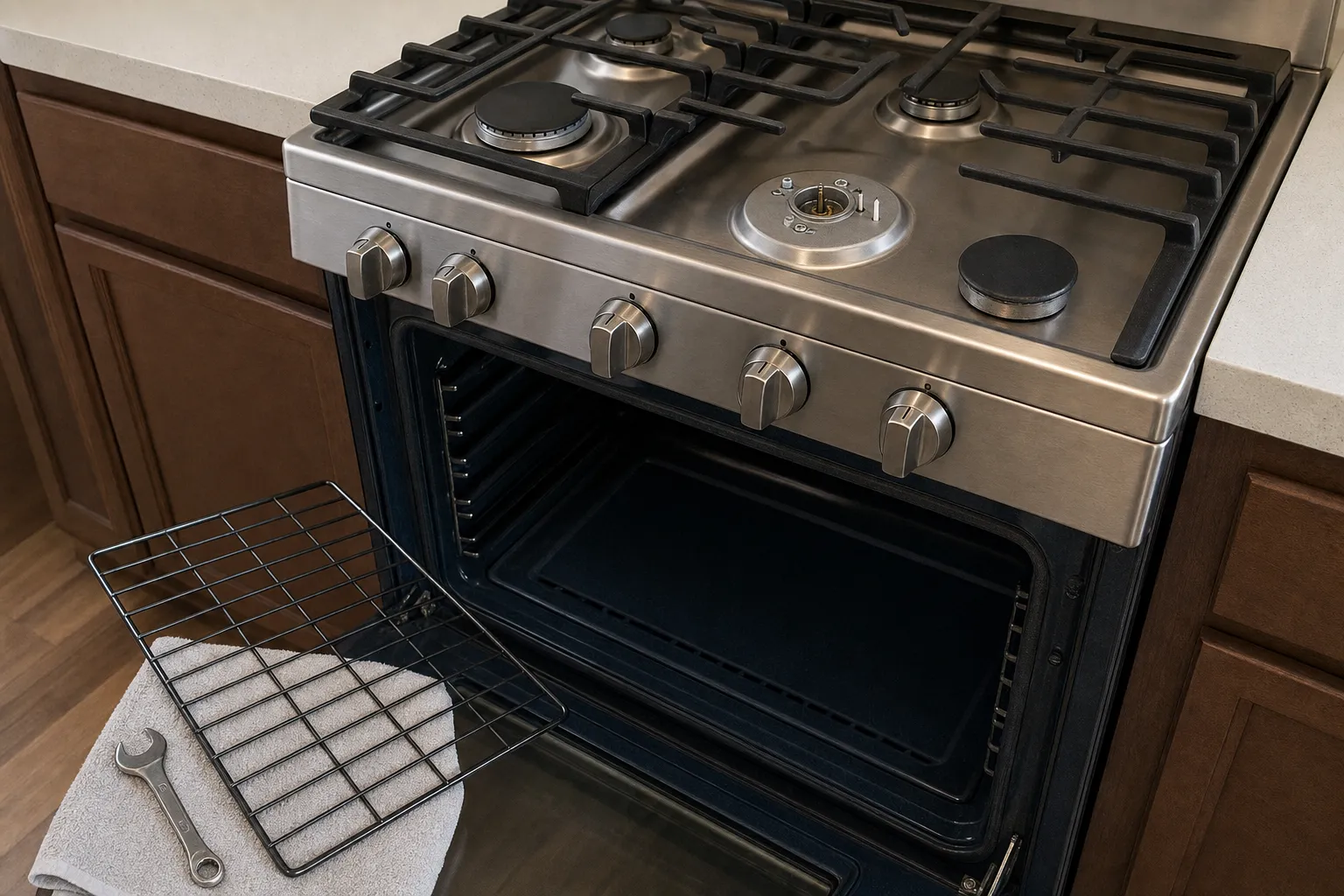
Wolf Oven Repair
Wolf Oven Baking Cold: Sensor Drift, Element or Control Board
A Wolf oven that sits well under its set temperature is rarely a dead control board. How to tell sensor drift from a failed bake element before you agree to the most expensive part on the list.
- Written by
- Greg Lindqvist
- Trade
- Cooking-appliance technician — gas ignition and burners
- Years at it
- 18
- Page dated
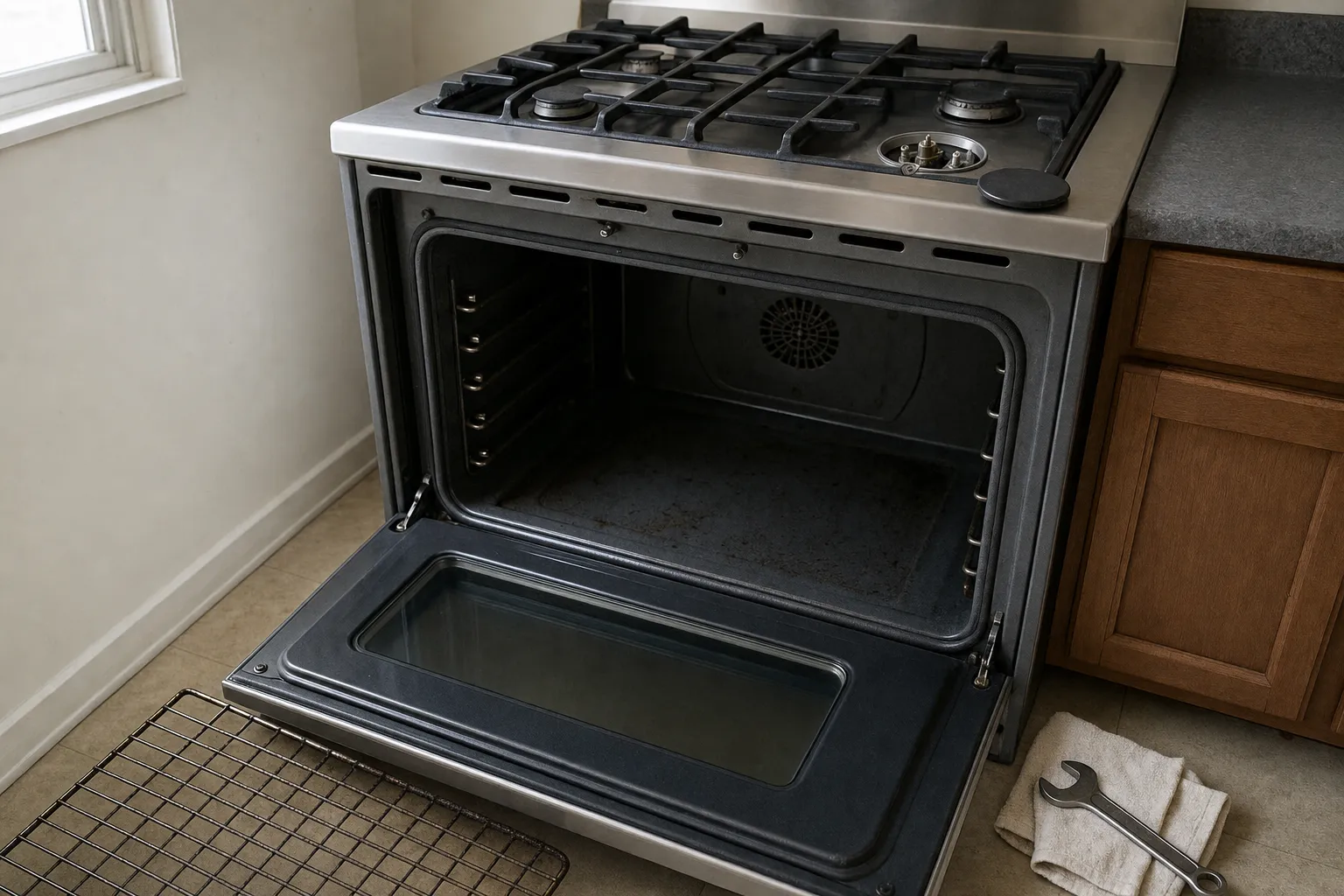
An oven that browns the top of everything and leaves the base pale, or takes ninety minutes to do an hour’s roast, is one of the most common calls we take on Wolf equipment in Redmond. It is also one of the most commonly misdiagnosed. The phrase “it needs a new board” gets used early and often, and on a dual-fuel range that is an expensive place to start guessing.
In practice the order of likelihood runs almost exactly the other way round. The control board is the last thing we look at, not the first.
Prove the gap before you chase it
Before anything gets opened, the fault needs a number attached to it. Oven thermometers that sit on a rack are fine for a rough check but they respond slowly and read the air near the door. What matters is steady-state cavity temperature.
Set the oven to 350°F, let it preheat, then leave it a good while longer so the cycling settles. Take readings across several full cycles rather than one. A healthy oven swings a little either side of the setting, and that swing is not the fault you are looking for. What you want is the average.
If the average sits close to the setting, the oven is behaving and the problem is somewhere else: a door gasket letting heat out, a convection fan that has stopped circulating, or genuinely just a recipe. If the average is well below and stays there, you have a real fault and it is worth going further.
Sensor drift is the usual answer
The oven temperature sensor is an RTD — a resistance temperature detector — and its whole job is to tell the control how hot the cavity is. As it ages, its curve shifts. It does not fail outright; it starts lying, and it usually lies in the same direction, telling the board the oven is hotter than it really is. The board believes it, stops calling for heat, and the oven settles well below the number on the display.
The test is a meter reading compared with the resistance chart for that sensor. Its resistance climbs predictably as it heats, so a sensor that reads off the chart at room temperature is drifting, and by the time the cavity is hot that small cold error has become a large one.
This is by far the most common cause of a Wolf oven baking cold, and it is a single-part repair. The sensor is a probe on the rear cavity wall, wired through to the back of the oven.
When it is the element instead
A bake element that has failed at one end behaves differently, and the difference is visible. A completely open element means no bake heat at all — the oven runs on broil-assist and preheats forever without ever getting close. A partially failed element, or one with a hairline break that opens as it expands, gives you an oven that preheats acceptably then loses ground once the door has been opened.
Look at the element cold. Blistering, a bright spot, a sag in one leg or any sign of arcing at the terminal all point at it. Then it is measured across its terminals and the reading compared with what its wattage calls for. An open circuit is definitive. A reading in range does not fully clear it, because thermal breaks only show up hot, but combined with visible damage it usually settles the question.
On dual-fuel ranges remember the oven is electric while the cooktop is gas. Burners lighting normally tells you nothing at all about the oven circuit.
The board, and why it comes last
Control boards do fail, and when they do the failure is rarely subtle. A relay that has welded or burned shows up as an element stuck on rather than an oven running cool. A board with a failed driver gives you no heat, not slightly less heat.
The specific pattern of “everything works, temperature is just consistently low” is a measurement problem, and measurement lives with the sensor. Replacing a board on that symptom usually produces an expensive oven that still bakes cold — and by then the sensor has been ruled in by elimination rather than by testing, which is the long way round to the same answer.
There is one honest exception. If the sensor tests correct at several temperatures and the element measures healthy, and the oven still will not hold setpoint, the board’s own reference has drifted. It is uncommon. It is not where you start.
What is worth doing yourself
Checking the door seal costs nothing. Close the oven on a strip of paper at the top, the sides and the bottom of the frame in turn; wherever it pulls free with no drag, the seal is not touching. A gasket that has gone hard lets out enough heat to show in your baking.
Beyond that, the honest line is the meter. Sensor and element testing mean taking panels off a wired appliance, and on a built-in wall oven, getting the unit out of the cabinet, which is a job for a technician rather than an evening project. A visit that measures first costs less than one wrongly ordered control board: Redmond Wolf Repair, (425) 905-2822.
Common follow-ups
How far out does a Wolf oven have to be before it counts as a fault?
Some swing either side of the setting is normal, because the oven heats in bursts and coasts between them. A fault is an average that stays well below the setting across several of those bursts, read with a separate thermometer after the oven has held heat for a good while. Redmond Wolf Repair, (425) 905-2822, measures it the same way.
Can I recalibrate the oven myself instead of repairing it?
Where your oven offers a temperature offset in its settings, it suits a small, steady drift on an oven that is otherwise healthy. It is the wrong answer to a large gap, because the offset only hides a part that is failing, and the gap usually keeps growing until the part is replaced.
Why does the display say 375°F when the oven clearly is not?
The number on the panel is the control's estimate, built from the sensor's report. If that sensor reports more heat than the cavity really holds, the control cuts the heat early and still shows the temperature you set. So the display cannot settle the question; a separate thermometer in the middle of the oven can.